Robotic Bronchoscopy
Robotic Bronchoscopy: Precision Lung Diagnostic Technology
Robotic Bronchoscopy represents a major technological leap in interventional pulmonology and diagnostic chest medicine. By fusing real-time robotic controls with advanced 3D navigational mapping, this high-precision system allows physicians to navigate the lung’s deepest, most delicate airways with sub-millimeter control. Designed specifically to access previously unreachable peripheral nodules, this technology transforms how early-stage lung diseases and pulmonary lesions are identified and diagnosed.
How the Technology Works: Advanced 3D Navigation & Guidance
The core innovation of robotic bronchoscopy lies in its integration of GPS-like navigational logic, algorithmic trajectory planning, and high-precision mechanical guidance:
Digital Airway Mapping (Pre-Procedural 3D Reconstruction): Prior to the procedure, high-resolution CT scan datasets are loaded into the system’s planning software to generate a customized 3D digital "road map" of the patient’s unique bronchial tree.
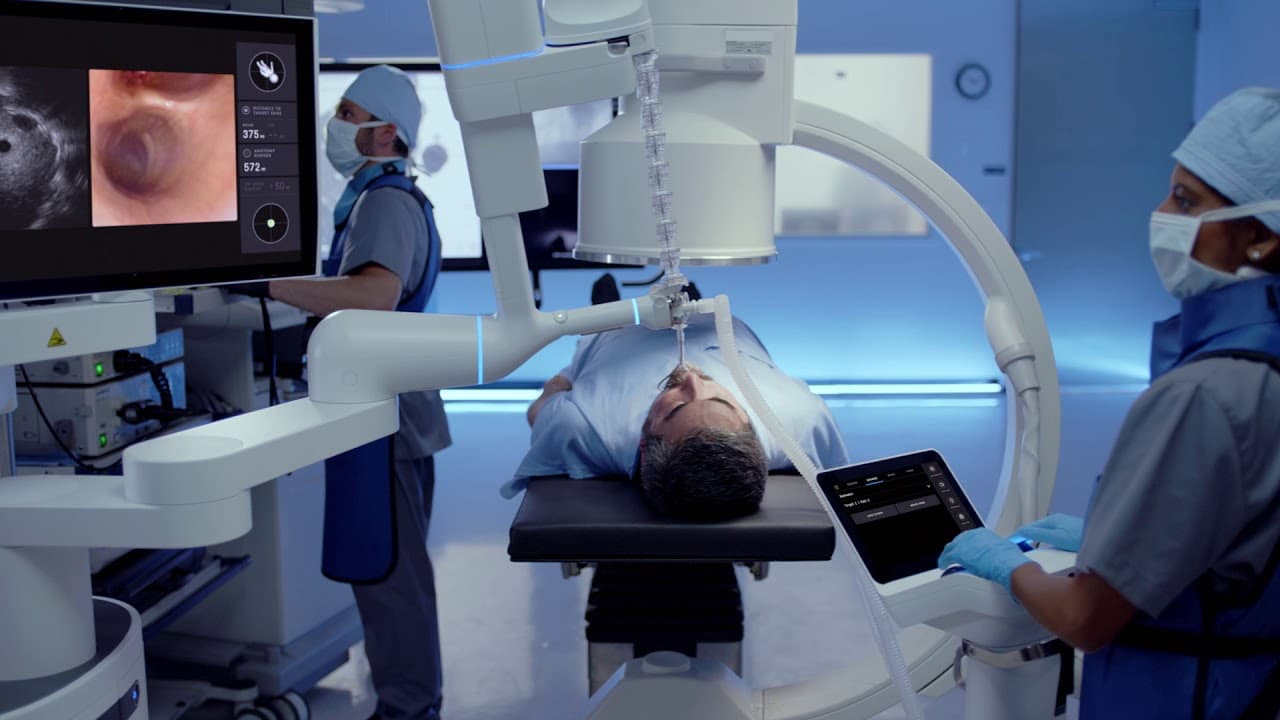
Robotic Articulation & Continuous Tension: Using an ergonomic controller, the operator guides an ultra-thin, flexible robotic catheter. The robotic arm maintains constant structural tension and maneuverability, preventing the instrument from drifting or slipping in narrow passages.
Extended Peripheral Reach: Unlike traditional flexible bronchoscopes, the ultra-slim robotic catheter can navigate past the 8th and 9th generations of bronchial branching, reaching tiny nodules in the outer edges of the lungs.
Technical Features & Diagnostic Capabilities
Robotic bronchoscopy systems incorporate several key technological features designed to optimize accuracy and tissue yield:
Real-Time High-Definition Visualization
Integrated micro-optics deliver a direct, real-time visual feed of the internal bronchial walls, enabling continuous visual feedback and precise alignment along the planned navigation pathway.
Robotic "Lock-In" Target Stability
Once the catheter arrives at the target nodule, the robotic system mechanically locks its position in all axes. This rigid stabilization prevents target deflection during needle passage and biopsy tool actuation, ensuring tissue samples are extracted precisely from the center of the lesion.
Intraoperative Optical & Fluoroscopic Integration
The platform integrates smoothly with real-time radial endobronchial ultrasound (r-EBUS) and cone-beam CT (CBCT) systems, allowing doctors to confirm three-dimensional tool-in-lesion placement before acquiring biopsies.
Key Clinical Applications in Respiratory Medicine
While widely recognized for its role in early-stage thoracic oncology, robotic bronchoscopy is a versatile technology deployed across multiple diagnostic and therapeutic applications:
Early Lung Cancer Detection: Enables safe access and accurate sampling of small, deep-seated peripheral nodules ($<2\text{ cm}$), facilitating early diagnosis when options are most effective.
Fiducial Marker Placement: Delivers sub-millimeter placement of gold seeds or dye markers around pulmonary tumors to guide precise stereotactic body radiation therapy (SBRT) or targeted surgical resections.
Deep Lung Tissue Sampling: Safely extracts fluid, brushings, and core tissue samples from deep pulmonary segments to identify complex fungal, bacterial, or mycobacterial infections.
Indeterminate Nodule Evaluation: Resolves diagnostic uncertainty for peripheral spots or ground-glass opacities (GGOs) discovered incidentally on routine CT imaging.
Engineering Advantages, Cost & Patient Benefits
By leveraging natural respiratory pathways, robotic bronchoscopy provides significant performance, financial, and safety advantages:
Cost Efficiency: While advanced robotic bronchoscopy ranges between $12,000 and $25,000 in the US and Europe, international patients can access the technology in India for $2,500 to $5,000 (achieving up to 70% savings inclusive of specialized biopsy consumables and 3D mapping).
Incisionless Approach: Operates entirely through natural anatomical airways via the mouth, eliminating external skin cuts, surgical wounds, and visible scarring.
Reduced Airway Trauma: The ultra-thin, flexible design minimizes friction and shear forces against delicate bronchial mucosa, reducing post-procedure inflammation and bleeding risks.
Enhanced Safety Profile: Mechanical stability drastically lowers the risk of accidental lung puncture (pneumothorax) compared to transthoracic needle biopsies.
Streamlined Diagnostic Pathways: High diagnostic yield reduces the need for repeated tests, enabling medical teams to proceed immediately with definitive care planning.
Frequently Asked Questions (FAQs)
How does robotic bronchoscopy differ from traditional flexible bronchoscopy?
Traditional flexible bronchoscopes are wider and guided manually, limiting their access to the central and mid-level airways. Robotic bronchoscopy utilizes an ultra-thin, computer-guided robotic catheter that can travel much deeper into the narrow peripheral branches of the lung while maintaining complete position stability.
How does the system ensure accurate biopsy placement?
The technology uses 3D virtual CT navigation combined with continuous robotic stability. Once at the target site, the robotic arm locks in place so the catheter cannot shift, allowing the physician to deploy biopsy instruments directly into the nodule under guidance.
What technologies are combined during a robotic bronchoscopy procedure?
Robotic bronchoscopy typically integrates 3D CT navigational software, micro-camera optics, robotic articulation drives, and often intraoperative ultrasound (r-EBUS) or fluoroscopy to confirm accurate tool positioning prior to sampling.